Wednesday Oct 11th
Today I had to take the car out at lunch for an errand. I drove about a mile and got on the 101 freeway (at Laurel Canyon Bld. heading west) once on the freeway I noticed that the engine came up to temp quickly, probabley because I had driven it about 6 hours earlier. I debated as to switch to veggie or not but decided to do it. I got off a few miles & exits later (Van Nuys Blvd. and headed to Ventura Blvd.).
While I was sitting in the left turn lane onto Ventura Blvd. I heard what sounded like the engine pulsing. I looked at the tach and could see the RPM's dropping slightly then going to back up to the normal idle (about 820 RPM). I thought that was strange and swicthed back to diesel.
I drove about 3 more blocks to my destination and went inside for about 10minutes. I came out and decided to take ventura blvd. back to work and swicthed to oil. I drove about 2 miles and while sitting in traffic the car shut off without warning. I tried to restart but to no avail.. I was lucky as I was able to push the car directly into a parking lot .
I put it back on diesel and popped the hood. I briefly checked the new 3/8" brass tee I installed over the weekend but didn't see any leaks. The tee is on the return portion of the IP and is for a new temp gauge. The car has been fine up to today, Wednesday. I worked on it Sunday
I tried to start it (and get the oil out of the lines in case the engine cooled). I cranked it several times for 20-30's. As I cranked it it sounded like it was getting easier for the starter to turn until it finally started. I moderately reved it a couple times and returned to work on diesel - about a 1/2 mile with out incidence.
I didn't swicth to veggie for a couple days until I could look for an air leak. This was strange because of the way it just shut off. It's never done anything like it. Total fuel starvation while on Veggie. I emailed Craig at Plantdrive and he said chances are that it was an air leak, especially since I just openned the system. The only thing I could find as a possible cause was one of the hoses on the temperature tee had a 1/8" gap at the end and the clamp was a slightly smaller and not as tight as it should have been. One other thing was that I didn't pipe seal the temp sender in the adapter as per the directions for the temp gauge. The only other thing I can think of in terms of an air leak are the threads on the new temp tee. I sealed them as I have in the past so I didn't mess with them as I want to deduce a cause by elimination.
Friday Oct 13th
After replacing the hose clamp with a better one and eliminating the 1/8" gap by sliding the hose all the way onto the hose barb I swich to veggie after returning home from work. The car seems to run fine while idling in my garage.
Saturday Oct 14th
I take it out for a run and do some errands. I decide to go to veggie a few blocks from the house. After a minute or 2 the car stalls. I get it restarted on Diesel and head home. Looks like I now have plans for my Saturday.
Since I've more or less checked & rechecked all the hose clamps & fittings I figure perhaps it's a clogged filter. I figure I'll disconnect the line after the vegtherm and hook up my hand bulb pump to see if I can get Veggie to flow freely so I know it is reaching the IP. (sorry forgot to take a pix) I throw the switch on the Pollak to veggie & pump. I hear what sounds a like a sucking sound from underneath the car by the fuel tank. I look and see a fresh pool of veggie oil on the garage floor. I'm imediately relieved to find the source of the problem. I don't know what it is yet but it's not a loose connection.
 I look closer and realize it's coming from the aluminum veggie line. I feel around and find that a support hook for the brake line has punctured veggie line. The weight of the three lines resting against the tip of the hook over the last 3 months caused it to wear through the tubing.
In the picture, above right, are the 2 coolant lines on top with the veggie on the bottom resting on the point of the hook The one in the hook is the brake line wrapped insulation to protect it from the heat of the system. The 2 rubber ones are the diesel supply & return. Left, is a close up of the puncture.
 Since it's a small hole, in the middle of the line, and I don't have a flaring tool to repair it, I decide to patch it with a piece of rubber tubing & hose clamp. After the repair, I took it out for a drive today and it didn't stall on veggie or appear to be leaking. I'll keep checking it over the next few days/weeks. . . . .
I dewater my oil, filter to 2 microns, and only use liquid oil. If it was a clogged filter I would have lost faith in the system. The conversion is a pretty simple concept the problem is I keep interfering with it to experiment and improve my set up.
While I was sitting in the left turn lane onto Ventura Blvd. I heard what sounded like the engine pulsing. I looked at the tach and could see the RPM's dropping slightly then going to back up to the normal idle (about 820 RPM). I thought that was strange and swicthed back to diesel.
I drove about 3 more blocks to my destination and went inside for about 10minutes. I came out and decided to take ventura blvd. back to work and swicthed to oil. I drove about 2 miles and while sitting in traffic the car shut off without warning. I tried to restart but to no avail.. I was lucky as I was able to push the car directly into a parking lot .
I put it back on diesel and popped the hood. I briefly checked the new 3/8" brass tee I installed over the weekend but didn't see any leaks. The tee is on the return portion of the IP and is for a new temp gauge. The car has been fine up to today, Wednesday. I worked on it Sunday
I tried to start it (and get the oil out of the lines in case the engine cooled). I cranked it several times for 20-30's. As I cranked it it sounded like it was getting easier for the starter to turn until it finally started. I moderately reved it a couple times and returned to work on diesel - about a 1/2 mile with out incidence.
I didn't swicth to veggie for a couple days until I could look for an air leak. This was strange because of the way it just shut off. It's never done anything like it. Total fuel starvation while on Veggie. I emailed Craig at Plantdrive and he said chances are that it was an air leak, especially since I just openned the system. The only thing I could find as a possible cause was one of the hoses on the temperature tee had a 1/8" gap at the end and the clamp was a slightly smaller and not as tight as it should have been. One other thing was that I didn't pipe seal the temp sender in the adapter as per the directions for the temp gauge. The only other thing I can think of in terms of an air leak are the threads on the new temp tee. I sealed them as I have in the past so I didn't mess with them as I want to deduce a cause by elimination.
Friday Oct 13th
After replacing the hose clamp with a better one and eliminating the 1/8" gap by sliding the hose all the way onto the hose barb I swich to veggie after returning home from work. The car seems to run fine while idling in my garage.
Saturday Oct 14th

I take it out for a run and do some errands. I decide to go to veggie a few blocks from the house. After a minute or 2 the car stalls. I get it restarted on Diesel and head home. Looks like I now have plans for my Saturday.
Since I've more or less checked & rechecked all the hose clamps & fittings I figure perhaps it's a clogged filter. I figure I'll disconnect the line after the vegtherm and hook up my hand bulb pump to see if I can get Veggie to flow freely so I know it is reaching the IP. (sorry forgot to take a pix) I throw the switch on the Pollak to veggie & pump. I hear what sounds a like a sucking sound from underneath the car by the fuel tank. I look and see a fresh pool of veggie oil on the garage floor. I'm imediately relieved to find the source of the problem. I don't know what it is yet but it's not a loose connection.
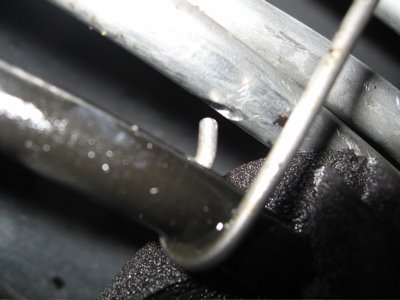 I look closer and realize it's coming from the aluminum veggie line. I feel around and find that a support hook for the brake line has punctured veggie line. The weight of the three lines resting against the tip of the hook over the last 3 months caused it to wear through the tubing.
In the picture, above right, are the 2 coolant lines on top with the veggie on the bottom resting on the point of the hook The one in the hook is the brake line wrapped insulation to protect it from the heat of the system. The 2 rubber ones are the diesel supply & return. Left, is a close up of the puncture.
 Since it's a small hole, in the middle of the line, and I don't have a flaring tool to repair it, I decide to patch it with a piece of rubber tubing & hose clamp. After the repair, I took it out for a drive today and it didn't stall on veggie or appear to be leaking. I'll keep checking it over the next few days/weeks. . . . .
I dewater my oil, filter to 2 microns, and only use liquid oil. If it was a clogged filter I would have lost faith in the system. The conversion is a pretty simple concept the problem is I keep interfering with it to experiment and improve my set up.