Oct 11th 2007
I came across this post while googling "WVO TDI Jetta". I can not stress enough that one should weigh the advantages and disadvantages to using SVO in a modern diesel. Here is a followup thread from Greasecar.com
I had previously spoken with the owner of the above mentioned car, I was referred to him by Plantdrive since he also had a Jetta TDI and their TDI kit. He had been running his for about 2 years before I installed mine and was located in Atlanta. I spoke to him over the phone because I just wanted a users feedback and he I had a couple questions. 2 things come to mind when I compare my situation with his and the gentleman running the 2005 Passat who has had similar problems and a stock Plantdrive kit.
In both situations I believe they switched over to vegetable oil to soon, not giving the engine time to get hot enough. The Passat owner mentions in his earlier blog postings that he would switch over a few minutes after starting the engine. The other gentleman mentioned when I spoke with him that he switched over as soon as the water temp gauge started moving, as this indicated that the thermostat had opened up for flow to the heater core. IMHO, this does not mean that the engine is at operating temperature. I am also running additional heaters on my car.
There are 2 problems that I am aware of with vegetable oil, one is viscosity and the other is proper burning of the oil in the combustion chamber - the atomization of the fuel if you will. If the fuel doesn't burn right - and it's arguable that it ever does - the excess oil cokes (gunks up) the piston rings allowing engine oil to mix with crankcase oil and it destroys the lubricancy of the motor oil. This leads to scoring of the piston wall, the gunking of the valves and damage to other parts of the engine due to friction.
Second, if the veggie oil is heated it reduces viscosity, reducing strain on the IP and providing a better spray pattern for the injectors. A hot engine will burn the oil fully by helping to vaporize the oil in the chamber. Frybrid has a good analogy on their site along with other great resources -
"Imagine placing a pan on the stove, pouring a small amount of vegetable oil in the pan, and turning the heat to high. The pan will begin to heat up and as it does it will heat the oil, around 300F the oil will start to smoke, then turn black, stick to the pan. . . . . (get a new pan and) turn the heat on high again. When the pan gets to about 600F throw a tablespoon of oil in the pan, just before it bursts into flame singeing whatever is left of your eyebrows, you will notice that the oil is skittering around the pan on a layer of vapor, none of the oil is sticking to the pan and none of it is turning to carbon.
This is what happens in your engine.
Anther thing I remember about my conversation with the gentleman in Atlanta was he told me that he would drive to work and not purge, leaving the car for several hours before restarting it on oil. This is a major error never do anything along those lines. Sure I don't purge for 20 minutes pit stops if it's a summer day, but anything longer or colder then that I purge.
The other thing both drivers did not do is dewater the their oil. I'm not really sure of what water does exactly other then I heard that is will damage the IP and pit the combustion chamber. As with everything else I say - take it with a grain of salt and make your own conclusions
I purchased a car with 126,ooo miles on it and I'm willing to see how far I get. I happen to change my oil roughly every 3ooo miles just because I don't drive that much and I always did it with my gasoline vehicles. I use soy oil which is the worst offender for contaminating the engine oil because of it's chemical make up but it is the most readily available.
Suggestions:
- Pick a high mileage car & a car out of warranty
- Make sure the engine is hot before switching over and the oil is as hot as is practically possible
- purge the oil back to the oil tank and don't mix it with the diesel tank - especially if the tank is small
- Dewater and filter your oil down to at least 5 microns
- Change oil in 1000 to 3000 mile increments
Realize that:
- Over a period of time you may be damaging the engine
- Driving longer distances is better as the engine is hot and it will burn the oil better
- You are a beta tester and may be ruining your car in the process.
Tuesday, October 16, 2007
The Bad news

Wednesday, July 11, 2007
Overhaul of Waste Vegetable oil system on '02 Jetta TDI
Just some notes about this overhaul, most of which I have probabley mentioned before. The car initially had a stock Plantdrive TDI kit installed . Getting a better understanding of things, or at least my opinions about them led me to change and add some things.
What I don't like:
- My car has no hose over hose(HOH) or hose in hose(HIH) on the fuel lines. Nor do I have a heated fuel tank. If I were to do it again would added the heated fuel lines. But I am in a realatively mild climate and it was a son of a gun to run those aluminum lines under the car . Most of my oil run under the car is uninsulated aluminum tubing - this I would not do again
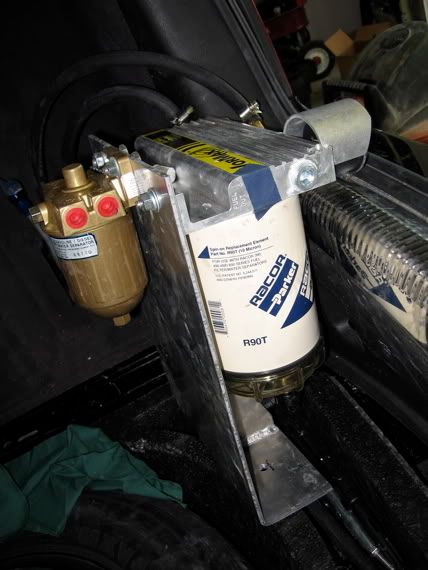
- The Vormax (FPHE) is in the trunk. This to me does not seem like a good idea as there is heat loss on the way up to the engine bay & a section of oil is unheated before the Vegtherm for the initial switchover.
- The 2 micron Racor filter attached to the back of the Vormax is unheated. Again if I was to do things again I would use something else, perhaps a Frybrid TDI filter or the new Vegmax thast Plandrive sells. I would not go through the hassle of wrapping the Racor. I only did it because I had some leftover tubing around.
I have noticed a quick change in temperature when I do the initial switch over but after that the change is not as great as I had hoped. In other word when I switch over the oil will go to 100º rather quickly but after that it take time more time then I would like for it to reach 160º.
I'm thinking that the heater coil around the Racor is more of a passive heater. The quanity of oil it is heating is more then is needed and it can not heat that amount of oil quickly.
To fix this I bought the Frybrid Heated filter. I have yet to receive it but I will replace the racor filter and homemade heater coil with this. My thinking is that the new heater will be using the same amount of heat to heat a smaller quanity of oil because it passes through the heater exchange on it's way to the IP.
I still have to insulate the lines and do a little replumbing. I will install the Frybrid heater at that time. Perhaps by the end of the month
Wednesday, February 21, 2007
Thoughts on future mods
Upcoming mods
I've debated on how to improve the system but the more I think about it I would rather start from scratch on another car - perhaps a Jetta wagon. Currently the car works and there does not seems to be any problems. I do not have the time to modify this one too heavily - the original convertion took me a week. After the install I kept tweaking it the more I learned about how it works. If I were to do another install I think I could do it in 2 days - barring any waiting on parts.
This summer I hope to achieve a few things that are easier to do and will help both my winter and summer driving. When I initally installed the kit we were in the midst of record breaking heat wave that lasted over a month with temps consistently over 100º. There were points when the temp of the oil may have been getting too hot for the IP. This is one reason I don't know if I should insatll a FPHE in addition to the Vormax in the trunk
Install additioanl 3 way valve
This will serve 2 purposes:
- It will let me return the oil (and some diesel) back into the veggie tank from the looped return when purging. This will reduce or eliminate veggie in the diesel tank. The downside of this is that while purging I will be pulling diesel out of an already small 5 gallon tank that is not returned to the tank, this means more fuel ups of diesel.
- The other benefit, and it relates to hot weather use, is I can eliminate the looped return while running on veggie and return the hot oil back to the veggie tank rather then putting it back directly into the fuel loop. How effective this is to heat reduction is questionable but I don't think it will hurt.
Install a coolant shut off valve
- Another item is a shutoff ball valve to prevent coolant from going to the Vormax , if I choose, so that I can go back to diesel in the stock full tank if I ever want to. Because of the 4.5G doughnut diesel tank I can not drive along distance on diesel. With my current commute I have to fill up with diesel once every other week. This frequency would really never change because once the car is running on Veggie I could go hundreds of miles and still use the same amount of diesel because I have to start on diesel and stop on diesel so the amount I drive on veggie - barring any long stopping periods (the engine cools off) is irrelavant.
Running strictly on diesel is something I could do during the winter months and never switch over to veggie. I would simply shutoff the coolant to the Vormax, refill the empty stock tank with diesel. The fuel going through the Vormax is not heated. My veggie lines under the car are not very insulated so they can go back to carrying diesel with very little heat gain . . .at least I think so.
Another benefit of shutting off coolant to the Vormax wold be on hot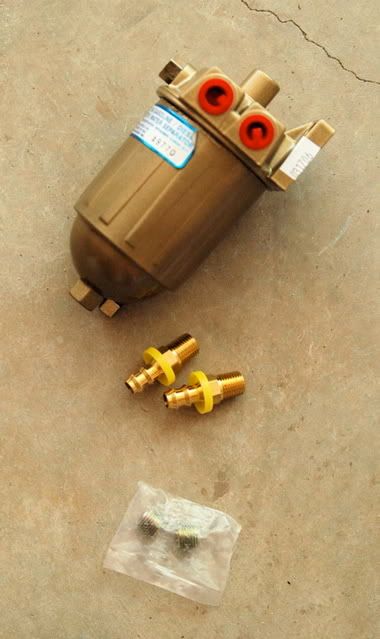
Plantdrive adds a 2 micron racor filter to their TDI kit. I don't understand why because the stock filter for the diesel fuel is 10 micron. Frybrid sells a heated TDI filter housing and it uses a stock VW filter. I guess there's no harm in filtering more then is needed.
Currently in my installation the the Racor is attached to the back of the Vormax housing in the trunk. I've noticed though that the racor does not get hot, at least not very quickly. This just seems to be something that should be heated to lessen stress on the IP. My plan is to move the racor to the engine bay and wrap it in a coolant jacket, similar to the one that Dana Linscott offers plans for on his website. This hopefully will lessen the viscoscity of the oil in the filter and also provide heated oil to the engine at swicthover to VO.
With the Vormax is in the trunk, the section of veggie line between the vormax and IP contains unheated oil at switchover (my lines are not heated). If I wrap the racor in aheated jacket and place it in the engine bay the initial section of oil to reach the IP will be somewhat warmed up.
I haven't decided on whether to use rubber or aluminum tubing as the heater element. Dana Linscott recommends rubber because of the amount of contact it provides to the item you want to heat. I have some left over aluminum tubing from the initial install so I think I may use that and wrap it in insulation. At the same time I will try and heat a portion of the veggie line that I can access with a HOH application. This coupled with the looped return, I hope,will increase the temp of the oil that is intially injected into the engine at switchover.
Monday, November 20, 2006
The Oil I use (currently)
I thought I would mention the particular oil that I use in my Plantdrive kit. The Plantdrive kit requires liquid oil. That is to say no Crisco or hydrogenated oils - it must be flowing at room temperature or colder. It can not be grease, part of the reason is their approach to tank heating and the Vormax would clog if oil congealed in it, as the filter and bowl take a while to heat up. They make this very clear in their sales material.
Currently I am catered at work and I should have this job for another year or so. After that it may change because I am freelance and go from job to job. Some jobs last a day others several years.
The caterer saves the oil for me. Because we are mobile they work out of one of those "roach coach" trucks. They don't store the oil on site, they either give it to the commissary or take it back to they're main kitchen for disposal using the cubees it came in. They don't use large quantities of oil every day but we have fries, Chinese, tempura, and other various items that are fried once or so a week. I would say I average 4-5 gallons a week. They fry the food and they're done with the oil. Currently this is plenty because I live close to work and the Jetta SIPS fuel.
It is non hydrogenated soy* and used once. He sets it aside to let it cool then at the end of my shift I come buy and pour it back into a cubee using a homemade funnel from the Greasecar forum with a paint strainer installed. Evidently soy oil is not the best oil to use because of it's particular makeup. It's more susceptible to polymerization.
Contrary to popular approach, I did not secure a source of oil before starting the conversion. Besides being confused about the whole filtering process I was concerned about "taking over" the oil removal from a source. I didn't want the responsibility nor did I think I would need that much, again this car gets mid 30's MPG. My idea was to do the conversion, get the car working, and in the meantime purchase some new soy oil from Costco. I figured getting a source of oil would be the least of my concerns I also was fairly sure I could get the oil from work (I work seasonally and was not working when I converted the car).
*I have to watch as the have snuck in a couple of "creamy" - READ: partially hydrogenated cubees of soy which I have inadvertently mixed in with the good soy
Saturday, November 18, 2006
Water leak solved - I think
129,900
About a month later it came on again, I thought that was strange. I filled it up and about 2 weeks later it came on again. At this point, I was hoping that since I had previously filled the reservoir when the engine was hot that the coolant receded and this caused the low reading. This wasn't to be as in another 2 weeks the light came on again and the fliud was low.
 There were no puddles on the floor so I was a t a loss for where the fluid was going. The motor oil wasn't whitish, as some folks had told me this was an indication of a blown head gasket - water in the engine oil. I thought that was unlikely as I didn't mess with any of that stuff during the install.
I had seen some red "crusty crystals" on the hose that connects to the heater core that I had "tee"ed into for the coolant supply. I decided to look at that while engine was still hot. Sure enough their was a small about of liquid at the rim of the hose. I think what happens is that if the engine gets hot enough the water leaks from this location as vapor. That would explain why there are no puddles and no visible leaks and why the gap between refills is so long.
I think what happened during the install was that I used a razor blade to remove the OEM hose from the one inlet. After I removed it I noticed a few grooves I had cut into the plastic inadverantly with the razor blade trying to cut off the hose. I only did this to one hose. The other issue is that the replacement hose I used was 3/4" - not an exact match to the metric hose that was previously on the bib. Perhaps these crusties formed because of the slits and slight oversize of the new hose in the bib and created the leak.
At the time of the install I could have cut the OEM hose but decided that new hose would be easier to work with.
I tightened the hose clamp that had the water leak a little more - it wasn't what I would call loose. I've done acouple long drives - over 30 miles each way and have not seen a drop in fluid level. It's been about 3 weeks. Hopefully this is the source and the leak is fixed.